
 admin
admin 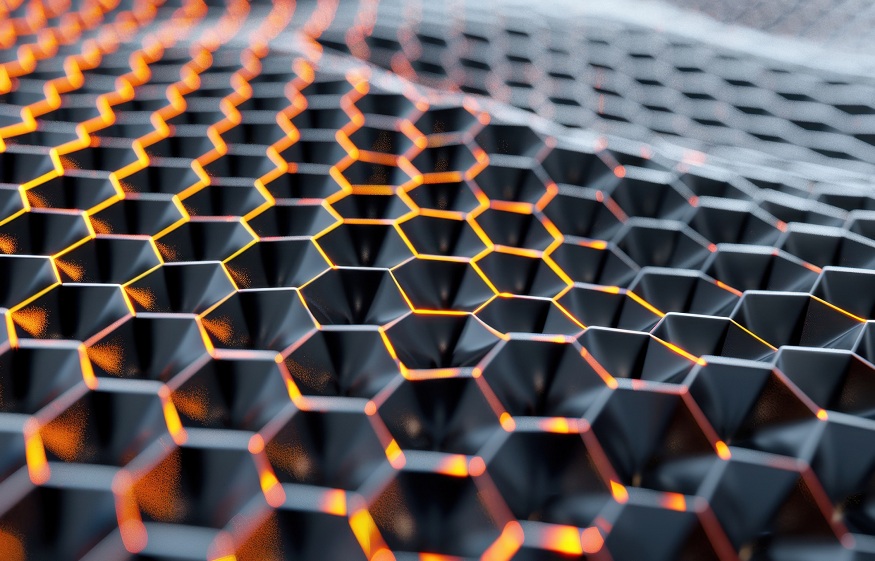
Geometric honeycomb structure in a macro image. The interconnected dark gray and black hexagonal cells feature a subtle orange glow at the joints. The low depth of field and soft focus enhance the abstract concept of technology or science in the design.
Nature frequently offers the most effective designs for engineering answers. Bees discovered, millions of years ago, that hexagonal cells are the most material-efficient and strongest structures. Engineers today use this knowledge to create amazing construction materials.
Why Hexagons Rule the Engineering World
Shapes with six sides fit together seamlessly, leaving no gaps. In contrast with squares or triangles, hexagons evenly distribute stress throughout their entire structure. This structural benefit renders them remarkably powerful with minimal material usage. Engineers utilize this concept to design lightweight panels capable of bearing massive weights. An individual sheet can weigh only a few pounds while being able to hold the weight of multiple vehicles. The key is found in the mathematical precision of the hexagonal design.
The Material That Makes It Work
Synthetic fibers make up the principal material. It resists heat, chemicals, and friction. The fibers start as a paper-like sheet, then they are molded into a honeycomb shape. The production process changes seemingly simple material into something remarkable. Heat treatment enhances the connections among fibers. Chemical treatments enhance resistance to moisture and various environmental factors. The outcome is a substance that functions consistently under conditions that would ruin numerous other options.
Read More: Google Workspace Plans Reimagined: AI and SD-WAN for Maximum Business Impact
Strength Through Smart Design
According to the experts at Axiom Materials, the Nomex honeycomb structure achieves its remarkable strength through clever engineering principles. Every cell distributes its burden among adjacent cells. When force strikes one region, it disperses throughout the whole structure instead of focusing on just one point. This load distribution avoids the severe failures that affect solid materials. Honeycomb structures bend instead of breaking. They absorb shocks that would break other materials.
Weight Savings That Transform Industries
Aerospace engineers are highly focused on minimizing weight. Every pound taken off an aircraft reduces fuel expenses over countless flight miles. Conventional solid panels offer durability but also significantly increase weight drawbacks. Honeycomb panels address this issue effortlessly. They provide similar strength while being much lighter. A honeycomb panel can be 90% lighter than a solid metal sheet yet offer comparable load-bearing strength.
Applications Beyond Aviation
Although aircraft manufacturers took the lead, other sectors swiftly acknowledged the benefits. Race cars use honeycomb panels for impact resistance. Marine designers include them in boat hulls that must be both sturdy and lightweight. Construction firms have begun utilizing these materials for panel fabrication. They are perfect for modern buildings because they are strong, lightweight, and insulate against heat. Skyscrapers can feature lightweight walls that are more robust and offer superior insulation.
The Science of Sound Control
Honeycomb designs are highly effective in managing noise and vibrations. The air contained in each cell efficiently absorbs sound waves. This renders them important for uses where minimizing noise is as crucial as structural integrity. This acoustic performance is advantageous for recording studios, production plants, and transportation vehicles. The structure that offers strength also fosters quieter surroundings.
Thermal Performance Advantages
Air confined inside the honeycomb compartments serves as inherent insulation. The transfer of heat significantly decreases in comparison to solid materials. This thermal resistance aids in keeping temperature regulation in challenging situations. Spacecraft utilize this characteristic to safeguard delicate instruments from severe temperature fluctuations. Designers utilize it to enhance energy efficiency in commercial buildings.
Conclusion
The basic concepts of honeycomb structures are still inspiring advancements in various sectors. Engineers continually discover innovative methods to utilize these geometric benefits to address contemporary issues. Engineers anticipate that these exceptional materials will become increasingly prevalent. This is because of advancements in manufacturing methods and declining costs. Occasionally, the most effective solutions arise from emulating nature’s proven designs and implementing them with contemporary materials and exact manufacturing techniques.